

You probably thought you were done having to hear about yarn structure from me. You are almost right. This will be the last of that for a bit…but I do have a little bit more to add. I’ll be referring back to information from previous posts on Waiting for Rain, so check those out again if I lose you here.
Even considering gauge, as well as fiber content, there’s still the actual structure of the yarn which needs to be considered. This is a bit of a potpourri of a topic. Lots can affect what I’m referring to as structure. Both gauge and fiber type have a role of course, but mostly it’s the construction style I’m talking about now. For typical yarn, that means spinning style. However, a chenille, or a ribbon yarn would also apply to this section.
 One of my favorite, relatively inexpensive yarns is Lion Brand’s Homespun. It has such beautiful colors (yes, while I can be an ass about using color as the defining consideration, I do recognize it can be *a* consideration), it feels so soft. However, as you can see, it’s all bumply. What this means is that it doesn’t show stitch definition. The good of that: you can screw up a whole bunch and no one can see. The bad of that: you can work your ass off with a beautiful stitch pattern, and no one will be able to see it. This yarn makes wonderful garter stitch blankets. They look super cozy (and actually are), and they are super easy to make. If you are not one to like a concert hat, perhaps this would make a good concert knitting project for you. So, this probably won’t be my first choice for Waiting for Rain. Unless I only did the garter in this, and found something to go with it for the lace panels.
 This is a singles spun yarn, which means that it is not plied like many other yarns. It is also a warm yarn, but it is smoother than the Homespun, so it would show definition. I made a wonderful cabled blanket out of it. With the leftovers, I’ve made several twined knitted hats for Poopie. Which he loves. However, because it is only spun in one direction (rather than spun, and then plied in the opposite direction), the twisting of the knitting, and twisting of the yarns for the twining technique means that it frequently untwists enough to fall apart, so I have to do a lot of splicing in the hats. This is why I try really, really hard not to tell people they can’t or shouldn’t do something. Conventional wisdom is that you “shouldn’t” use singles for twined knitting. However, these are truly Poopie’s favorite hats. They are a giant PITA to make, though. So while I won’t say you “shouldn’t” use singles for twined knitting, I will say you “should” make sure the project/recipient is worth the extra effort you are sure to need to put in. This yarn would be a perfectly reasonable choice for the shawl, the color repeats are long enough to not be super busy and detract from the lacework.
 This yarn is an interesting yarn to discuss. If you look at the “core” of it, it is a laceweight. However, it has a wide halo around it. The ball band calls it a bulky. I think this is because you should probably use larger needles to give that halo enough freedom to “bloom”. While this is an acrylic yarn, this type of construction is similar to what you would see with rabbit (which, yes, I know, I didn’t talk about last yarn structure post). Yarns with this construction seem to me to most often be the super warm yarns. They look so delicate, but they are soooooo cozy. If you spin a more robust yarn with rabbit, you could go to the North Pole. For me, this construction of yarn works best with a simple lace design. I think you need the holes of the lace to let the halo really shine, but that halo will make it difficult to really see the lace. If I’m going to be working charts and tearing out rows, I want the casual observer to *know* I busted my ass to do that, and I want them to be totally jealous of my skills. Fuzzy yarn just doesn’t do that. However, it makes a super easy lace chart look like you *did* do all that hard work. Better than having everyone ooh and aah over a complicated pattern is to have everyone ooh and aah over something super easy. I’m a big proponent of making my yarn work harder than me. You may think that’s lazy. I choose to say it’s smart. Tomayto/Tomahto.
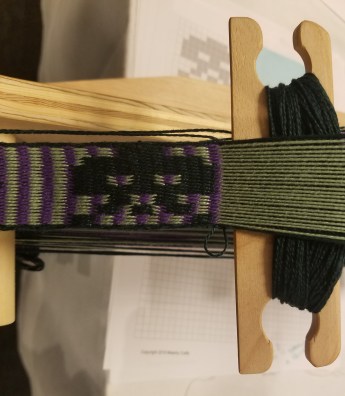 My favorite John story from that day was one of the ladies had warped her loom funky. I didn’t see/hear exactly what she did. But, that meant her piece wasn’t doing what she wanted it to do. John went over to her, and figured out it was the warp, and not her weaving. He said something to the effect of he didn’t want her to feel bad about her weaving, she was doing great. She did need to feel bad about her warping, though. Keep in mind, she comes to many of his classes, and he develops wonderful rapport with all of his students. So, in the moment, we all laughed (she included). The warp was fixed, and she carried on. Auntie Pam bought me a loom, and John signed it for me.
 Spinning with Judith is always a joy. She had me putting random things in with my fiber, which is how I ended up with this lichen yarn. She’s just so matter of fact about spinning, I love her so much. There’s never anything that we shouldn’t try. She tells us what the potential pitfalls may be, but never says “don’t do that”. Granted, it’s spinning, not anything that’s going to blow up. The worst thing that will happen is the yarn will fall apart. Oh well. I did see these totally awesome spinning wheels that are in little pseudo briefcases…







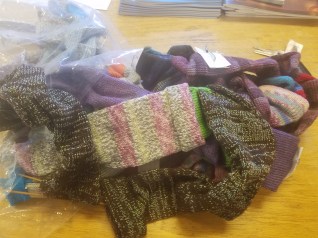 As you can see, most of my Wednesdays were quite filled with the lovely kitchener stitch. I know many people who cannot stand the kitchener stitch. I have no idea why. Just like anything else, it’s a bit complicated and/or fussy when you first start. But truly, it is a wonderful thing. The kitchener stitch can be used to join two pieces of knitted fabric seamlessly. Honestly, once it’s done and gone through a wash, you can’t tell it’s even there. When I was initially taught the stitch, I was warned to not do anything else. Have no distractions! My knitting ladies can tell you, I can now do many, many things at the same time as stitching up toes. I now have a rhythm.
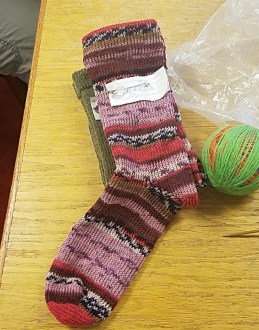 For me now, the kitchener stitch is something I can do with ease. I don’t dread it, and I don’t just suffer through it. Instead, it’s just another part of making a sock. What my teacher said is no longer true for me. She wasn’t wrong when she said it, but that reality has changed for me. I changed that reality. Which is pretty powerful when you think about it.
 La Tejedora Crafts