

Sound familiar? If your mom never said this to you, then I don’t believe you are really human. This post is about following directions…-ish. In my knitting group, we are just as likely to call a pattern a recipe, as anything else. It may be that we are old and have problems with words. BUT, I’m going to tell you that it is because patterns are like recipes, and you should treat them the same way. So, you should read through the entire thing. You should gather your tools (remember all the blogs on yarn?). And then you can start. I do this every time (wink, wink).
Before Christmas, I have about three craft/cooking days. Things 1 and 2, as well as O all have many gifts to give. We started a while ago making gifts. Thing 2 has her process down pretty pat, and then will add something in to keep things interesting. Thing 1 and O do different things every year. One of the things I really try to stress is to read through the whole recipe (or pattern) to make sure you know what you need to be doing and when. This is intended to keep the comments of “oh, oops!” to a minimum. We are all fairly terrible at this step (or we forget in between times), so it’s heard pretty frequently. Except Thing 2’s day…Thing 2 and I swear like sailors when we screw up.
Aaah, screwing up! That’s what crafting is all about. Screwing up, and recovering from those screw ups. A couple weeks ago, I had to pull out 10 rows of the Waiting for Rain shawl because I *thought* I had remembered how to do one of the increases. I mean, sure, it had been several weeks since I’d worked on the shawl, and that time was working the lace insert, but I remembered. Except, I didn’t. So, the lesson one would be expected to learn from this is that when one puts down a project, one should re-read the pattern *again* to re-acquaint oneself with the pattern. I can pretty much guarantee that Future Tejedora will be having a similar moment later on. She keeps thinking she’s smarter than she is.
This would be like when Thing 2 and I were going to make a cheesecake for my brother. We read through the whole recipe like good little cooks–or, rather, skimmed. In the skimming, we missed that there are something like 15 different baking steps, for different times and temperatures. I might be exaggerating, but not by much. Oh, oops. Still tasted fine.
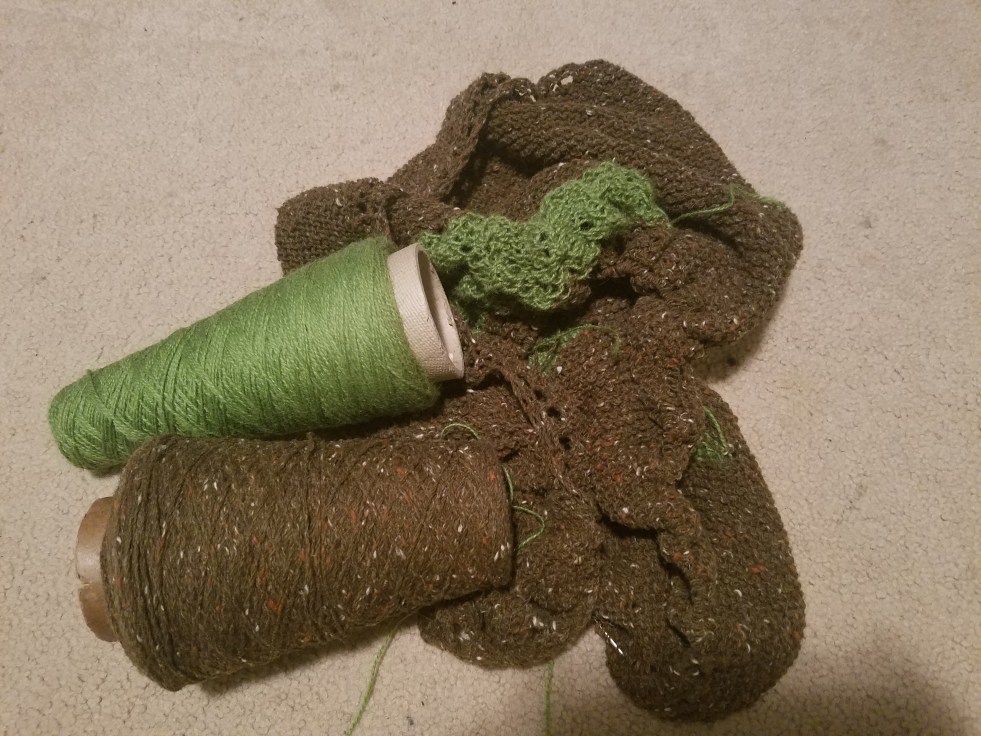
Occasionally, though, you do read the pattern/recipe, and you do follow the directions, but they still don’t make sense, or you still screw up. There can be many reasons for this. In the featured photo, see how there’s a section of nice and neat, and then 1/2 way along, stupid purl bumps? I followed the directions!!! I really did!!!
Well, except, I modified the pattern for two colors vs. one. But that doesn’t count, right? Well, um, yeah, it does in this case. So, I had made an adjustment, but I didn’t carry that adjustment throughout the project. It’s like doubling a batch of chocolate chip cookies, but not doubling the chocolate chips. It’s fine, I guess. In this case, I did not take into account how my alterations would necessitate altering directions later on. The way the lace happens in this pattern, you do short rows of stockinette lace, and then when you are done, you just knit off into the sunset. But, that means that only 1/2 of your lace insert is knitted on that row. When you come back, the rest of the lace insert is knitted, but now, it’s showing as purl. So, an adjustment must be made. I chose to leave this like it is on this first insert. It’s rustic looking anyway, it’ll be fine. But, in the next insert, on the way back, I switched from knit to purl on that last 1/2, so the insert is all smooth. This *does* mean that I have a section of not quite garter for one row, but that was more acceptable to me than the 1/2 in 1/2 out visual experience that dogmatically following the rules gave me. OK fine, you purists!!! *dogmatically following the rules after I threw them out the window in the first place. I suppose one should learn to follow a change through the whole process to make sure one understands how the change could affect things in the future. One should also live a little.
And then, Dear Reader, there are the times you follow the directions, and it just doesn’t turn out. You re-look at the directions, and re-do it so many times, and it still doesn’t turn out. This happened to me this last year with a sweater I made for Poopie. The cable pattern was not coming out right. It was Elizabeth Zimmerman, so I was sure that it was me. Clearly, I was doing something wrong. I finally looked up the pattern elsewhere, and found there really was a typo in the Zimmerman book. This one clearly taught me that even our heroes are just people. And everyone needs a good editor.
Except me. I’m going to keep telling you my typos and formatting issues are part of my charm 🙂

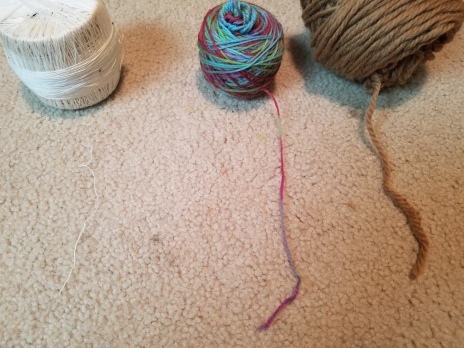
 One of my favorite, relatively inexpensive yarns is Lion Brand’s Homespun. It has such beautiful colors (yes, while I can be an ass about using color as the defining consideration, I do recognize it can be *a* consideration), it feels so soft. However, as you can see, it’s all bumply. What this means is that it doesn’t show stitch definition. The good of that: you can screw up a whole bunch and no one can see. The bad of that: you can work your ass off with a beautiful stitch pattern, and no one will be able to see it. This yarn makes wonderful garter stitch blankets. They look super cozy (and actually are), and they are super easy to make. If you are not one to like a concert hat, perhaps this would make a good concert knitting project for you. So, this probably won’t be my first choice for Waiting for Rain. Unless I only did the garter in this, and found something to go with it for the lace panels.
 This is a singles spun yarn, which means that it is not plied like many other yarns. It is also a warm yarn, but it is smoother than the Homespun, so it would show definition. I made a wonderful cabled blanket out of it. With the leftovers, I’ve made several twined knitted hats for Poopie. Which he loves. However, because it is only spun in one direction (rather than spun, and then plied in the opposite direction), the twisting of the knitting, and twisting of the yarns for the twining technique means that it frequently untwists enough to fall apart, so I have to do a lot of splicing in the hats. This is why I try really, really hard not to tell people they can’t or shouldn’t do something. Conventional wisdom is that you “shouldn’t” use singles for twined knitting. However, these are truly Poopie’s favorite hats. They are a giant PITA to make, though. So while I won’t say you “shouldn’t” use singles for twined knitting, I will say you “should” make sure the project/recipient is worth the extra effort you are sure to need to put in. This yarn would be a perfectly reasonable choice for the shawl, the color repeats are long enough to not be super busy and detract from the lacework.
 This yarn is an interesting yarn to discuss. If you look at the “core” of it, it is a laceweight. However, it has a wide halo around it. The ball band calls it a bulky. I think this is because you should probably use larger needles to give that halo enough freedom to “bloom”. While this is an acrylic yarn, this type of construction is similar to what you would see with rabbit (which, yes, I know, I didn’t talk about last yarn structure post). Yarns with this construction seem to me to most often be the super warm yarns. They look so delicate, but they are soooooo cozy. If you spin a more robust yarn with rabbit, you could go to the North Pole. For me, this construction of yarn works best with a simple lace design. I think you need the holes of the lace to let the halo really shine, but that halo will make it difficult to really see the lace. If I’m going to be working charts and tearing out rows, I want the casual observer to *know* I busted my ass to do that, and I want them to be totally jealous of my skills. Fuzzy yarn just doesn’t do that. However, it makes a super easy lace chart look like you *did* do all that hard work. Better than having everyone ooh and aah over a complicated pattern is to have everyone ooh and aah over something super easy. I’m a big proponent of making my yarn work harder than me. You may think that’s lazy. I choose to say it’s smart. Tomayto/Tomahto.






 La Tejedora Crafts